|
Difficulty Rating System |
 |
Hiking and Climbing
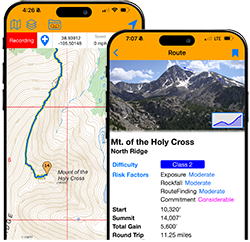
The routes on 14ers.com have been given a difficulty rating or
"Class". I am using a rating system that has been in use in the
United States for over 75 years. The system contains classes ranging from
1 (easy) to 5 (difficult). Here’s a brief description of the Class ratings:
| Hiking |
Class 1 |
Easy hiking - usually on a good trail. |
| Class 2 |
More difficult hiking that may be off-trail. You may
also have to put your hands down occasionally to keep your balance.
May include easy snow climbs or hiking on talus/scree. |
| Climbing |
Class 3 |
Scrambling or un-roped climbing. You must use your
hands most of the time to hold the terrain or find your route.
This may be caused by a combination of steepness and extreme terrain
(large rocks or steep snow). Some Class 3 routes are better done
with rope. |
| Class 4 |
Climbing. Rope is often used on Class 4 routes
because falls can be fatal. The terrain is often steep and
dangerous. Some routes can be done without rope because the
terrain is stable. |
| Class 5 |
Technical climbing. The climbing involves the use of
rope and belaying. Rock climbing is Class 5. Note: In
the 1950s, the Class 5 portion of this ranking system was expanded to include a decimal at
the end of the ranking to further define the difficulties of rock climbing.
This is called the Yosemite Decimal System (YDS). The decimal notations range from 5.1 (easiest)
to 5.14 (most difficult). Recently, the rankings of 5.10 through
5.14 were expanded to include an "a", "b",
"c" or "d" after the decimal (Example: 5.12a) to
provide further details of the ranking. None of the routes
described on 14ers.com are Class 5, so I will not go into detail of the
expanded decimal system. |
Keep in mind that Class 1 through Class 4 rankings are not very descriptive
and do not have any further breakdowns like Class 5. Class 2 is very
general and includes a wide range of hiking. At times, Class 2 routes may
include dangerous terrain (exposure, loose rock, steep scree, etc.). Just
because a route is ranked Class 2, does not mean it is safe or easy. The key to Class 3 is that you are almost always using
your hands to move up through the steep terrain (snow or rock). In some
cases, I may describe a route as "Difficult Class 2",
or "Easy Class 3" to provide more detail.
Snow Steepness
Introduced by Gerry Roach, the following is a simple
rating system for describing the angle of a snow slope:
| Rating |
Steepness Range |
| Easy |
0-30 Degrees |
| Moderate |
30-45 Degrees |
| Steep |
45-60 Degrees |
| Very Steep |
60-80 Degrees |
| Vertical |
80-90 Degrees |
Backcountry Skiing
For ski routes, the simple Novice/Intermediate/Advanced/Extreme scale is used. A novice-rated 14er ski route does not mean it's as easy as a green trail at the ski area - it means the route is recommended for novice backcountry skiers who have at least some mountaineering experience and solid skiing skills. On the other end of the scale, extreme routes have a slope angle greater than 45° and likely include terrain features which may complicate your descent. Skiing a 14er is much different than visiting the ski area and the route difficulties should not be compared directly to ski area standards. In addition to this simple method of ski difficulty rating, for each ski route I have included ratings using the "D System" by Lou Dawson. A specific set of skills is required to ski in the backcountry and ski routes can be steep, dangerous, and difficult. On many routes, a fall could be fatal.
THE
STEEPS: Slope angle plays a large part in
the difficulty of a ski route. An advanced slope will often exceed 40
degrees. If a slope is over 45 degrees, it is usually difficult to stop a
fall. A fall on a slope over 50 degrees could result in your demise.
The first time I looked down a long 55 degree slope, my brain had trouble
forcing my skis over the edge. Few ski areas in North America have any
runs that exceed 55 degrees. Silverton Mountain
ski area, in Colorado, has some of North America's steepest ski area terrain - with maximum
angles of 55 degrees. Learn to ski steep runs at the ski area before
heading to a steep backcountry route. It's vital to master the "jump-turn"
technique. The jump-turn is useful on steep, narrow routes where carving
is difficult. Expect to see ski tracks on terrain that you consider
unsuitable for anyone with a brain. Another person's idea of advanced or
extreme may differ from your own.
TERRAIN + CONDITIONS = LEVEL OF DIFFICULTY:
Steepness is not the only factor when determining the difficulty of a
backcountry ski route. At a minimum, consider the following factors when
planning a descent: Slope angle, snow condition, avalanche danger, sun
hit, cliffs, rocks, ICE or hard snow, route exits, run-out, wind, and
visibility. It's a great idea to climb what you are going to ski. If
you feel it's too steep to climb, then it's probably too steep for you to ski.
During a climb, you will be able to identify the desired path of your descent.
You may also spot that drop-off that you can't see from the top.
It's critical to know when something is beyond your ability before you are in a
tough situation. If you are an expert ski mountaineer, you will
eventually peer down your first "no-fall" route. This is usually a good
time to consider your future in the backcountry. Don't fall.
Copyright © 2013 14ers.com®, 14ers Inc. All Rights Reserved.