Threads related to Colorado mountaineering accidents but please keep it civil and respectful. Friends and relatives of fallen climbers will be reading these posts.
Forum rules
Please be respectful when posting - family and friends of fallen climbers might be reading this forum.
Eli Boardman wrote: ↑Tue Jul 21, 2026 12:56 pm
The usual response is "people will want to climb them all anyway, they can't be expected to learn all those skills." But the expectations are very different in other places.
I can just as easily point to the Catskills or the White Mountains out east where the expectations are mostly even lower then here.
It's pretty clear though that those skills aren't really necessary for the folks who go hike 14ers writ large. A few, specific individuals may benefit from some of those skills.
I think, to me, it's an error in comparison. Those skills are built by the communities you reference because they're necessary for those peaks and climbs. The community of folks in CO which is doing technical routes totally have those skills. It's just not the 14ers community because 14ers don't need them, ultimately. The proof for that is in the numbers: despite 265,000 hiker use days in 2024 (last numbers available from CFI), there were a handful of deaths.
I think you're correct that the things you listed would help some people. The culture around that won't change unless it becomes seen as necessary to have those skills. I don't see how or why that shift would happen.
To be glib and reductive, the 14ers.com forum has consistently has to remind folks to drink water, eat food, and put on sunscreen. I don't think we'll be getting those folks to learn proper alpine climbing skills.
MaryinColorado wrote: ↑Tue Jul 21, 2026 11:45 am
Little Bear has been a really hot topic on the .com Facebook page, which has produced some good dialogue but as of late certainly concerns about the accident that occurred. So i have linked a couple folks to your write-up. Very helpful to the 14er community at large. Thank you.
i continue to be concerned about this because the WRI has been widely advertised as being the "solution" to the hourglass route. while it had been gaining popularity before it was formally documented (yes, even on alltrails) i didn't have a shred of doubt that there would be a fatality. i certainly don't want to be disrespectful toward anyone- the victim, their partner, or to david (who has been kind enough to not only take several parties up there, but to carefully document it so that others have the most information possible)- but the phrase "there are no shortcuts" comes to mind when discussing peaks like little bear, capitol, or south maroon peak.
the list has been over-casualized by social media and a dynamic population climbing some of the easiest/most accessible peaks-- but some of the routes truly are harrowing. unfortunately, i don't think there's any way to get the point across except through tragedy. and even then, plenty of folks will still choose invincibility over common sense/skill progression/groupthink. sad part of the game, but it's definitely here to stay.
1. navigation | 2. illumination | 3. sun protection | 4. first aid | 5. shelter | 6. insulation | 7. fire | 8. repair | 9. water | 10. food | 11. hot sauce
ekalina wrote: ↑Tue Jul 21, 2026 2:03 pm
Ultimately, I don't think it's on us to gatekeep by limiting published route descriptions or refusing to provide beta. The responsibility to manage risk and make good choices in the mountains ultimately rests with the individual, which is both beautiful and terrible but makes mountaineering what it is.
But, what is the audience of a guidebook? (Here, I'm calling 14ers.com "a guidebook"). With expanded route descriptions and photos with lines and arrows, I would contest it's mostly beginners.
I agree with both these statements.
However, ekalina's statement about finishing a 14er list is probably true. Its mostly one and done. I would add that many of those finishing the 14ers may have minimal mountaineering skills. Even after 58 summits they're still intermediates at best. I've known several who just followed the leader. Couldn't find a route if their life depended on it. Couldn't find their way out of a jam. I use this site not just for routes, but for the input from experienced hikers/climbers... I value those the most (something beginners probably ignore or are unaware of). That said, this guide is just that. A guide. Choose your route wisely. Travel at your own risk.
- I didn't say it was your fault. I said I was blaming you.
two lunches wrote: ↑Tue Jul 21, 2026 3:05 pm
the list has been over-casualized by social media and a dynamic population climbing some of the easiest/most accessible peaks-- but some of the routes truly are harrowing. unfortunately, i don't think there's any way to get the point across except through tragedy. and even then, plenty of folks will still choose invincibility over common sense/skill progression/groupthink. sad part of the game, but it's definitely here to stay.
Couldn't agree more.
- I didn't say it was your fault. I said I was blaming you.
One of the 14ers.com forum's favorite things is to blame social media for some sort of declining quality standard.
It's ultimately a reductive, thought terminating cliche. It has been the dominant narrative for what is driving behavior in the mountains since I started participating here 8 years ago under a different account. Facebook is 22 years old. The iPhone's 20th birthday is next year. Social media and the internet has been part of the landscape of outdoorsmanship for even longer. These are not new phenomena.
It offloads any sense of community responsibility to a nebulous boogeyman. It's the 14ers equivalent of finding cross collaborative synergy between key stakeholders: self-soothing nonsense.
Quick take from an outsider slowing working on my Centennials and other extra interesting peaks.
Me and my partner usually hike in the northeast where there is a handful of mild class 3 routes (mostly marked trails) and a few class 4 slabs (ADK slides), so not much opportunities to learn scrambling skills, unless you go straight from hiking to proper rock climbing.
We have the 2 Roach guides and we used the 13ers one as main source for a couple peaks, but I would be lying if I didn't say that having the detailed version hosted here (and on the app) was critical to enable up to progress in the last 3 years (we're heading to the Sangres next week) from mellow 2+ routes to something like the Chicago Basin last year. I'm not sure if that make us tourists , but I'm skeptical that the best solution would be to remove detailed descriptions from this site and hope that things would be better (less rescues, injuries, death) with only AT/FB/IG as sources of information.
Last edited by sherby on Wed Jul 22, 2026 5:03 am, edited 1 time in total.
First I want to thank @daway8 for all the meticulous detail and generous guidance you have provided on WRI, but also just Little Bear in general.
I want to share my experience from today: I climbed Little Bear this morning from 8500' and took the Hourglass both up and down. I had no issues. There was some rockfall in the hourglass, but small, and minor. I also felt there were way more options to hedge against anything coming straight down the middle than any information I've seen online would have previously led me to believe. By no means am I discrediting the inherent risk present for anyone going through the HG. Perhaps a lot of luck was on my side today. But I did feel I had WAY more agency in mitigating rockfall with deep focus and attention, monitoring weather, going on a weekday, etc. etc. and I have a hard time accepting that anyone who successfully goes up and down the Hourglass without creating rockfall is just "lucky". Context matters, and it's hard to convey that online. I'm a strong athlete with a strong mindset and have developed my climbing skills over the past few years by granting myself permission to GO TRY, GO EXPERIENCE a mountain, even if it means not summitting. I had every intention to turn around at the HG and still call it a success today if I didn't like what I saw. But I also held space for encountering the best possible scenario, and was willing to gamble for it when I recognized the opportunity. I moved quickly and diligently through the HG both up and down. I'm saying this because I think climbers should be empowered by recognizing that they have the opportunity to gain experience in any capacity, at their comfort level, and that THAT is a positive thing... versus "summit or bust" or never even get out on a mountain because they're stuck in anxiety reading every bad story online.
Only saw 3 other men today, so it was certainly a good day to go for the summit. Two had turned back and one was in the Hourglass ahead of me but allowed me to pass just above the HG and we tag-teamed a bit towards the summit. (Shoutout to that guy!! It was his first 14er!!!)
Would love to try WRI in the future. I live on the East Coast though... so it'll have to wait till next year
Eli Boardman wrote: ↑Tue Jul 21, 2026 12:56 pm
The usual response is "people will want to climb them all anyway, they can't be expected to learn all those skills." But the expectations are very different in other places.
I think you're correct that the things you listed would help some people. The culture around that won't change unless it becomes seen as necessary to have those skills. I don't see how or why that shift would happen.
So, per the OP (and others in this thread) we must simply accept that there is no safe way up Little Bear, but simultaneously the skills to make it safer aren't really necessary? To be blunt, the "how and why" of how that shift would happen might be that people want to climb steep loose peaks and not die.
It's fine if people want to knowingly accept a higher level of risk for whatever reason (speed, convenience, etc.), but you can't deny that having more technical skillsets could make the 14ers safer in many circumstances (heck, even just simple raps on sections that might be loose and steep to downclimb).
It always seems common for people on the forum to overstate their case, which then typically leads to others overstating their position to try to counterbalance. Instead of rehasing that old routine, I'll try a few simple, balanced statements.
No amount of knowledge will ever provide a 100% guarantee of safety on any mountain, but increasing your knowledge of a route clearly can help mitigate risks.
No amount of skills (snow climbing, rope work, etc) will ever provide a 100% guarantee of safety on any mountain, but increasing your level of skill clearly can help mitigate risks.
Some people love climbing mountains in summer but have no interest in doing them in snow - it's just too darn cold (or whatever). That is totally fine - you don't need snow climbing skills to finish the list, so if you decide not to pick up that skill for one route on one mountain that has other alternatives, that's fine.
Some people love hiking up mountains and scrambling up to what they can handle but just have no interest in learning to use ropes. It's not strictly needed for any of the standard routes, requires extra weight, extra time, extra money for gear, etc - so if it's neither needed nor of interest, why do it? If you want to learn ropes - great! If you can do 14ers safely without ropes - great! Neither way is superior - do what you enjoy and what makes sense for a given route and let others do likewise.
Many, many people have safely climbed the Hourglass - I am one of them. I did it without knocking any rocks down and even coached someone doing it as their first ever 14er on how to walk carefully enough to not knock rocks down (after they had earlier sent missles flying over my head). A certain small percentage of people have been injured or even lost their lives in the Hourglass. Simple statistical probability dictates that most people doing the Hourglass will likely be fine but a certain small percentage will likely face tragedy.
A large and growing number of people have now safely climbed the West Ridge Indirect, while a small but growing number of people have turned back and one person tragically lost their life. Simple statistical probability dictates that most people doing the West Ridge Indirect will likely be fine but a certain small percentage will likely face tragedy.
Learning skills is great and always to be encouraged. I have learned many things over the years, continue to learn on a regular basis through both formal and informal methods and I still have a great deal to learn. But it's a well known fact that all of the 14ers can essentially be walked up (yes, with varying degrees of scrambling on a handful of the harder ones but the standard routes barely hit class 4 for the most part). So, if someone chooses not to learn ropes, that's fine. Ropes don't automatically make you safer - on some routes they can increase the risk of triggering rockfall and no small number of famous, skilled climbers have died rappelling off the end of their rope. Doesn't mean ropes aren't safe or shouldn't be encouraged - just means they're not a 100% fullproof guarantee of better safety in every case.
What's the bottom line? Little Bear is a dangerous peak. Not all routes are right for all people. Different people can get up the mountain safely by different techniques using different routes, tools, skills, etc. That's great! The best way to encourage safety is to give people options so they can choose what best fits them and knowledge so they can decide what sort of preparation they may need.
Eli Boardman wrote: ↑Tue Jul 21, 2026 12:56 pm
The usual response is "people will want to climb them all anyway, they can't be expected to learn all those skills." But the expectations are very different in other places.
I think you're correct that the things you listed would help some people. The culture around that won't change unless it becomes seen as necessary to have those skills. I don't see how or why that shift would happen.
So, per the OP (and others in this thread) we must simply accept that there is no safe way up Little Bear, but simultaneously the skills to make it safer aren't really necessary? To be blunt, the "how and why" of how that shift would happen might be that people want to climb steep loose peaks and not die.
It's fine if people want to knowingly accept a higher level of risk for whatever reason (speed, convenience, etc.), but you can't deny that having more technical skillsets could make the 14ers safer in many circumstances (heck, even just simple raps on sections that might be loose and steep to downclimb).
I don't think that's a fair engagement with the argument, come on.
The means used by the majority of people will dictate the expected skillsets of members of the community. It's norm setting. I tried to provide an explanation for why those norms are what they are.
It is the case that the majority of people climb LB successfully without technical climbing techniques. In contrast, the norms for something like Dreamweaver or The Casual Route are different. The norms are set where they are because they're broadly effective.
When I talk about the "how and why" I am, more specifically, referring to:
How do you change those norms effectively?
Why would the average climber care to change those norms if the current norms are effective for them?
I'm not denying that using more techniques allows more terrain to be traversed safely. To repeat myself, I don't see how or why that shift would happen.
daway8 wrote: ↑Mon Jul 20, 2026 6:49 pm
The standard Hourglass route has significant rockfall danger and there is almost nothing that can be done to mitigate that risk apart from trying to arrive when no one else is around, and even then people have experienced rockfall sometimes.
This is the one thing I would disagree with, there is a way to mitigate rockfall risk- by climbing the hourglass in spring with well consolidated snow gluing all those rocks together.
Having climbed all the 14ers in summer conditions, I distinctly remember LB as being one of the harder and scarier ones. But since I also went back and skied all of them in snow conditions, I would also say that LB doesn't even crack the top 10 in terms of difficulty with good snow cover. It's a pretty straightforward mellow day with snow, in all honesty. I've skied it twice, but I wouldn't think of doing it again in the summer.
Anyone considering the goal of climbing all the 14ers as a journey towards developing mountaineering skills, rather than just hiking, should consider learning how to snow climb and climb LB that way. It's by far the safest and IMO, most enjoyable way. It's no different than a Portland climber learning snow to reach Mt Hood, or someone from Seattle deciding to climb Rainier- a different skillset is required.

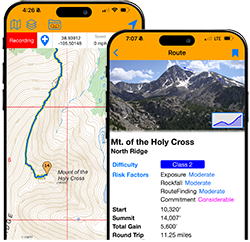




 , but I'm skeptical that the best solution would be to remove detailed descriptions from this site and hope that things would be better (less rescues, injuries, death) with only AT/FB/IG as sources of information.