
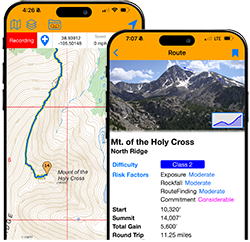


Ok, I need some advice.
I've only been hiking for a couple years now but I've started to up my game by doing hikes later in the season and also doing it alone. My work hours are odd enough that it's hard to plan with friends and hiking partners. I either go alone or don't go at all. And I've actually come to really enjoy the solitary experience.
But this combination -- hiking beyond July/August AND hiking alone -- is starting to freak out my parents and family. Again, I'm fairly new here, so I don't know how much this has been discussed on other threads. But am I crazy? I'm not doing really remote hikes (don't have time to make it down to the San Juan's much..); it's mostly 14ers and 13ers in eastern ranges and nothing too crazy (I haven't done anything in the Elks or Gores). I generally like high access hikes like in the Tenmile, Front, Sawatch, Mosquito, etc. I've done some snowshoeing and winter hikes, but they were generally with others. I'd like to go out more this coming fall/winter but it will most likely be alone -- but again, nothing too extreme. I get that hiking alone is riskier, because there is no one there to help, but I have an InReach and I carry the ten essentials. Any confirmation of my decisions against my family's worries?
Lastly, my mom sent me this old youtube video: https://youtu.be/cENu72QSwXU?si=4pKjfm9eYX9nyr74. I saw that Brad McQueen is on there and on this site. The one thing I haven't carried in my pack so far are items for an overnight emergency. I mean, I carry one of those emergency bivvies (by Sol) but I've never opened it. I don't carry a sleeping bag. Should I? Especially as it gets colder?
Sorry just to emotionally vomit here, but I would like to get feedback if I'm reckless or not. I'd be curious to hear people's opinions of hiking alone in the shoulder season and perhaps into winter. And secondarily, is bringing a sleeping bag important for emergency overnights?
Thanks
hiking alone / emergency gear for shoulder season
Forum rules
- This is a mountaineering forum, so please keep your posts on-topic. Posts do not all have to be related to the 14ers but should at least be mountaineering-related.
- Personal attacks and confrontational behavior will result in removal from the forum at the discretion of the administrators.
- Do not use this forum to advertise, sell photos or other products or promote a commercial website.
- Posts will be removed at the discretion of the site administrator or moderator(s), including: Troll posts, posts pushing political views or religious beliefs, and posts with the purpose of instigating conflict within the forum.
-
Taylor Doriani
- Posts: 14
- Joined: 10/11/2022
- Trip Reports (0)
-
LifeIsGood

- Posts: 111
- Joined: 4/30/2020
- Trip Reports (1)
Re: hiking alone / emergency gear for shoulder season
#1 I predict most forum members will consider you to be NOT reckless at all. But non-hikers/climbers will never understand the specific calculated risks involved.
#2 This whole conversation is completely different now, here in 2026, than it was even just a few decades ago: you have a satellite communication device, and gear that is light enough to carry overnight survival equipment.
#3 It has been said before, by plenty of well-known mountaineers, that this hobby can be rather selfish in many ways- put your family at ease as much as possible by emphasizing the simplicity of “walk-up routes” and providing plenty of info prior to every outing: TH, route, ETA, vehicle description, list of gear, etc.
#4 Carry a sleeping bag? Possibly yes, if it’s very lightweight, or just carry warm clothing. Most of us have a down jacket in our pack (often even in summer).
-
Taylor Doriani
- Posts: 14
- Joined: 10/11/2022
- Trip Reports (0)
Re: hiking alone / emergency gear for shoulder season
Yes, I do carry a down jacket. I wasn't sure that and an emergency bivy is adequate to "being prepared to spend a night out" especially in the colder months.#4 Carry a sleeping bag? Possibly yes, if it’s very lightweight, or just carry warm clothing. Most of us have a down jacket in our pack (often even in summer).
-
ekalina
- Posts: 363
- Joined: 8/10/2014
- 14ers: 23 1
- 13ers: 55 7
- Trip Reports (1)
Re: hiking alone / emergency gear for shoulder season
You're fine. Some will argue that it's less safe to hike alone, but I haven't found this to be universally true. I've seen (and been in) situations where partners are unprepared, overconfident, and/or group think and peer pressure set in, causing a person to do riskier things than they would have done on their own. Hiking alone, you have to strive to be at least as good alone as you would be in a group for it not to be riskier.
How can we achieve this? Some of my tips (I'm sure others will add more):
1) Select objectives that you're confident you can do safely on your own, and be conservative in your decision making. There are some routes/peaks I will do solo, some that I'll only do with partners, and some that I won't do either way. Knowing where these boundaries currently lie is key to ensuring your safety, and helps you learn about yourself, too!
2) Be an excellent navigator, since getting lost or off route is a common precursor to getting injured and/or having to spend an unplanned night out. Study the route beforehand, download route descriptions and photos, use a GPS device, have a map and compass (and know how to use them). You should have multiple ways to verify that you're where you think you are, not just one.
3) Monitor the weather forecast (recommend weather.gov, personally). Select big weather windows when you're going out alone (i.e., the weather isn't just good this morning or today, but also overnight and potentially into the next day). Ask yourself what happens if that snowstorm or windstorm starts 6 hours earlier than forecast. It happens all the time, so don't try to thread the needle.
4) Be prepared for an unexpected night out. Carry enough warm clothing and extra food that you could survive the night if necessary. Once we hit shoulder season I always carry a fleece, windbreaker, puffy, beanie, and thick gloves, along with an emergency bivy (SOL). If I needed to spend the night, I would find the most sheltered spot I could, deploy all of my layers, get in my SOL, and keep myself nourished until morning. Uncomfortable yes, but hopefully not deadly. This could absolutely be necessary to do when hiking with partners, too, and would be more dangerous if everyone isn't prepared.
5) Carry a SPOT or InReach device that will allow you to get help if needed.
Lastly, we have to acknowledge that there are some unfortunate but possible situations where it would be unequivocally better to have a partner. For example, you get knocked unconscious by rockfall and have no way to use the aforementioned SPOT/InReach and can't give yourself first aid (at least not right away). Hiking alone, we do our best to avoid finding ourselves in these situations, and acknowledge that this would be a bad spot to be in without a partner (or at least without a helpful bystander nearby). For me, however, there are plenty of objectives where these types of risks are manageable and small enough to be acceptable. Everyone has to decide that for themselves though.
How can we achieve this? Some of my tips (I'm sure others will add more):
1) Select objectives that you're confident you can do safely on your own, and be conservative in your decision making. There are some routes/peaks I will do solo, some that I'll only do with partners, and some that I won't do either way. Knowing where these boundaries currently lie is key to ensuring your safety, and helps you learn about yourself, too!
2) Be an excellent navigator, since getting lost or off route is a common precursor to getting injured and/or having to spend an unplanned night out. Study the route beforehand, download route descriptions and photos, use a GPS device, have a map and compass (and know how to use them). You should have multiple ways to verify that you're where you think you are, not just one.
3) Monitor the weather forecast (recommend weather.gov, personally). Select big weather windows when you're going out alone (i.e., the weather isn't just good this morning or today, but also overnight and potentially into the next day). Ask yourself what happens if that snowstorm or windstorm starts 6 hours earlier than forecast. It happens all the time, so don't try to thread the needle.
4) Be prepared for an unexpected night out. Carry enough warm clothing and extra food that you could survive the night if necessary. Once we hit shoulder season I always carry a fleece, windbreaker, puffy, beanie, and thick gloves, along with an emergency bivy (SOL). If I needed to spend the night, I would find the most sheltered spot I could, deploy all of my layers, get in my SOL, and keep myself nourished until morning. Uncomfortable yes, but hopefully not deadly. This could absolutely be necessary to do when hiking with partners, too, and would be more dangerous if everyone isn't prepared.
5) Carry a SPOT or InReach device that will allow you to get help if needed.
Lastly, we have to acknowledge that there are some unfortunate but possible situations where it would be unequivocally better to have a partner. For example, you get knocked unconscious by rockfall and have no way to use the aforementioned SPOT/InReach and can't give yourself first aid (at least not right away). Hiking alone, we do our best to avoid finding ourselves in these situations, and acknowledge that this would be a bad spot to be in without a partner (or at least without a helpful bystander nearby). For me, however, there are plenty of objectives where these types of risks are manageable and small enough to be acceptable. Everyone has to decide that for themselves though.
Last edited by ekalina on Wed Sep 23, 2026 5:53 pm, edited 1 time in total.
-
daway8

- Posts: 1704
- Joined: 8/24/2017
- 14ers: 58 31
- 13ers: 186 30
- Trip Reports (86)
Re: hiking alone / emergency gear for shoulder season
So I do 13ers/14ers year round and roughly 50% of the time I'm on my own (due to challenges with matching schedules, objectives, risk tolerance, etc).
Short answer; you're no more crazy than the rest of us!
But seriously, a Garmin InReach is really smart to carry. Also GPS with offline maps, battery pack to recharge if needed, headlamp with extra batteries etc.
As for sleeping bag - especially as you push into snow season that would be worthless if it's sitting on snow - you'd need to also have a mat to get it off the snow and by that time you're getting close to a winter camping setup which isn't practical for dayhikes (and if you do winter camp, there's a lot more to consider...).
Better option is plenty of layers including a heavy duty puffy to pull over everything, some handwarmers to stuff in your gloves, various layers for your head (fleece cap, merino wool hood, Gortex hood, etc). Those silver emergency blankets can help some too. Just make sure your layering scheme is easily adjustable to avoid overheating/sweating while you hike - sweat can be dangerous in winter.
Also check the ice fishing area in Scheels for a little foam pad to sit on - super helpful for winter camping but also possibly useful for a long dayhike or if getting stuck overnight since you can sit down without getting wet in the snow.
But there are lots of people with weird schedules here so maybe try the Climbing Connection part of the forum before you give up on that.
Short answer; you're no more crazy than the rest of us!
But seriously, a Garmin InReach is really smart to carry. Also GPS with offline maps, battery pack to recharge if needed, headlamp with extra batteries etc.
As for sleeping bag - especially as you push into snow season that would be worthless if it's sitting on snow - you'd need to also have a mat to get it off the snow and by that time you're getting close to a winter camping setup which isn't practical for dayhikes (and if you do winter camp, there's a lot more to consider...).
Better option is plenty of layers including a heavy duty puffy to pull over everything, some handwarmers to stuff in your gloves, various layers for your head (fleece cap, merino wool hood, Gortex hood, etc). Those silver emergency blankets can help some too. Just make sure your layering scheme is easily adjustable to avoid overheating/sweating while you hike - sweat can be dangerous in winter.
Also check the ice fishing area in Scheels for a little foam pad to sit on - super helpful for winter camping but also possibly useful for a long dayhike or if getting stuck overnight since you can sit down without getting wet in the snow.
But there are lots of people with weird schedules here so maybe try the Climbing Connection part of the forum before you give up on that.
-
mtree
- Posts: 1718
- Joined: 6/16/2010
- Trip Reports (0)
Re: hiking alone / emergency gear for shoulder season
You are not crazy.
I hike alone 95% of the time and for the same reasons as what you explained. Also, most of my friends have stopped hiking. I do have alot of experience and that counts for something. You'll gain it over time. I have a couple no-gos on my list.
#1 I keep my solo hikes below class 4.
#2 I stay out of potential avalanche terrain.
I always inform someone of my intentions and expected return and confirm when I'm down. I don't carry a sleeping bag, but dressing in layers with extra clothes in case of an emergency is always in my pack. Summer and most of fall is fairly safe from a freezing to death standpoint. Winter is the culprit. Your margin for error in the winter is very slim. Take that with alot of caution. Start small and figure out what works for you. Turning around is a safe and smart option if you question moving forward.
Most of winter hiking clothing is the same as my snowboard gear. There's alot of crossover.
LifeIsGood gave good advice.
I hike alone 95% of the time and for the same reasons as what you explained. Also, most of my friends have stopped hiking. I do have alot of experience and that counts for something. You'll gain it over time. I have a couple no-gos on my list.
#1 I keep my solo hikes below class 4.
#2 I stay out of potential avalanche terrain.
I always inform someone of my intentions and expected return and confirm when I'm down. I don't carry a sleeping bag, but dressing in layers with extra clothes in case of an emergency is always in my pack. Summer and most of fall is fairly safe from a freezing to death standpoint. Winter is the culprit. Your margin for error in the winter is very slim. Take that with alot of caution. Start small and figure out what works for you. Turning around is a safe and smart option if you question moving forward.
Most of winter hiking clothing is the same as my snowboard gear. There's alot of crossover.
LifeIsGood gave good advice.
- I didn't say it was your fault. I said I was blaming you.
-
ekalina
- Posts: 363
- Joined: 8/10/2014
- 14ers: 23 1
- 13ers: 55 7
- Trip Reports (1)
Re: hiking alone / emergency gear for shoulder season
One other thought: people, including family, tend to freak out or say it's crazy when confronted with things they don't understand. It's just how people are, and yet our lives are still our own. If there are people in your life who need to know what you're doing, then try to figure out how to put them at ease. For example, my InReach track auto updates every 20 minutes and gets published to my private map, which my wife keeps an eye on when I'm out. This puts her mind at ease if I'm a bit later than expected, and keeps me safer too.
Also, while I always tell someone responsible where I'm going, I don't necessarily tell the person in my family who thinks bears are going to kill us all. YMMV.
Also, while I always tell someone responsible where I'm going, I don't necessarily tell the person in my family who thinks bears are going to kill us all. YMMV.
-
zootloopz

- Posts: 176
- Joined: 8/26/2019
- 14ers: 58 2
- 13ers: 208
- Trip Reports (5)
Re: hiking alone / emergency gear for shoulder season
To add to what everyone else has said, practicing on routes as you become more experienced that are out and backs / have 100% defined trails so you're seeing the same thing you came up on the way back to the trailhead can be safer. Complicated routes that are loops or have substantial off trail travel obviously come with more potential complications.
The main thing I think about possibly happening when solo is a major leg injury that keeps me from walking, or has me walking very slowly.
I always make sure to have layers, emergency bivy, a compression wrap to stabilize an injury / bleeding, and the ability to have contact via phone or satcom as bare minimums in shoulder season.
Making sure to not rush in unstable terrain or suboptimal conditions will help to minimize injury risk.
The main thing I think about possibly happening when solo is a major leg injury that keeps me from walking, or has me walking very slowly.
I always make sure to have layers, emergency bivy, a compression wrap to stabilize an injury / bleeding, and the ability to have contact via phone or satcom as bare minimums in shoulder season.
Making sure to not rush in unstable terrain or suboptimal conditions will help to minimize injury risk.
one step at a time // you are exactly where you need to be in this moment
IG @roughlysomewhere
IG @roughlysomewhere
-
justiner
- Posts: 4942
- Joined: 8/28/2010
- 14ers: 3 1
- Trip Reports (40)
Re: hiking alone / emergency gear for shoulder season
As far as being prepared for overnight, at elevation, in Winter, there is the issue that this gear gets very expensive, a little heavy and a little bulky. There is a financial investment involved. I wouldn't skimp on the insulation. A 0F Comfort bag would be the absolute minimum. Maybe the rest you could negotiate. And saying that, I don't think I've ever gone out in Winter with overnight gear on a day trip.
I guess I'll also be the contrarian. I think the best safety gear is a partner -- and this is from someone who does basically all their trips solo. Doubly so for Winter and 3x for any avalanche terrain being negotiated. Chances you're going to dig yourself out of a slide are frighteningly low. Your satellite communicator is not going to work -- etc, etc.
No matter how prepared you are though, the fact remains is that winter hiking is very dangerous and you need to accept the risks involved that something can go very wrong. There is a literal survivorship bias built-in to a lot of advice that's going to be given.
Also, you don't have to hike at 13,000 - 14,000' year-round. The Front Range has a good collection of trails that stay pretty mellow weather-wise in the Winter.
I guess I'll also be the contrarian. I think the best safety gear is a partner -- and this is from someone who does basically all their trips solo. Doubly so for Winter and 3x for any avalanche terrain being negotiated. Chances you're going to dig yourself out of a slide are frighteningly low. Your satellite communicator is not going to work -- etc, etc.
No matter how prepared you are though, the fact remains is that winter hiking is very dangerous and you need to accept the risks involved that something can go very wrong. There is a literal survivorship bias built-in to a lot of advice that's going to be given.
Also, you don't have to hike at 13,000 - 14,000' year-round. The Front Range has a good collection of trails that stay pretty mellow weather-wise in the Winter.
Long May You Range! Purveyors of fine bespoke adventures
-
dwoodward13
- Posts: 934
- Joined: 3/26/2011
- 14ers: 58 12
- 13ers: 194 6
- Trip Reports (1)
Re: hiking alone / emergency gear for shoulder season
Looks like most of what I was going to say has been covered but one that hasn't is that I'd recommend attending the Winter Welcomer (viewtopic.php?t=66216&p=813640#p813640) and chat with different people on these exact things. Really exactly what its designed for. Who knows you might find a partner with weird schedules as well.
-
masonzastrow

- Posts: 29
- Joined: 1/22/2023
- 14ers: 58 7
- 13ers: 36
- Trip Reports (4)
Re: hiking alone / emergency gear for shoulder season
I've done a handful of solo winter 14ers, but the list of those summits is Quandary, Quandary, Quandary, and Quandary. If I'm getting into any avalanche terrain, or if I'm not familiar with a route, or if weather is questionable at all, I'll always go with a partner in winter. The risk factor is just too high for me to justify being out there alone (as much as I love hiking solo). With that said, these are decisions I'm making because I'm not carrying overnight gear, I'm not avy certified, and I don't have an InReach. If those amenities are in your budget, then your risk calculation is going to be different from mine and you may be just as safe while doing more.
I'll second Justin's point, if you're unable to hike with others due to scheduling, there's plenty of fun to be had in the front range or at lower altitudes. I'm partial to hiking Bear and South Boulder after a fresh dump of snow or snowshoeing in RMNP.
I'll second Justin's point, if you're unable to hike with others due to scheduling, there's plenty of fun to be had in the front range or at lower altitudes. I'm partial to hiking Bear and South Boulder after a fresh dump of snow or snowshoeing in RMNP.
-
mtree
- Posts: 1718
- Joined: 6/16/2010
- Trip Reports (0)
Re: hiking alone / emergency gear for shoulder season
The fact is if something bad happens to you hiking solo above 13k in the dead of winter (major injury, lost route, unexpected weather, etc.) your chances of survival drop to near zero if you have to survive more than a night. And that one night isn't all that encouraging either. Accept it.
As the saying goes... "Do. Or do not. There is no try."
Plenty of safer options out there.
As the saying goes... "Do. Or do not. There is no try."
Plenty of safer options out there.
- I didn't say it was your fault. I said I was blaming you.